

Key takeaways
- The mid-market rate is the midpoint between the buy and sell prices of a currency on global markets.
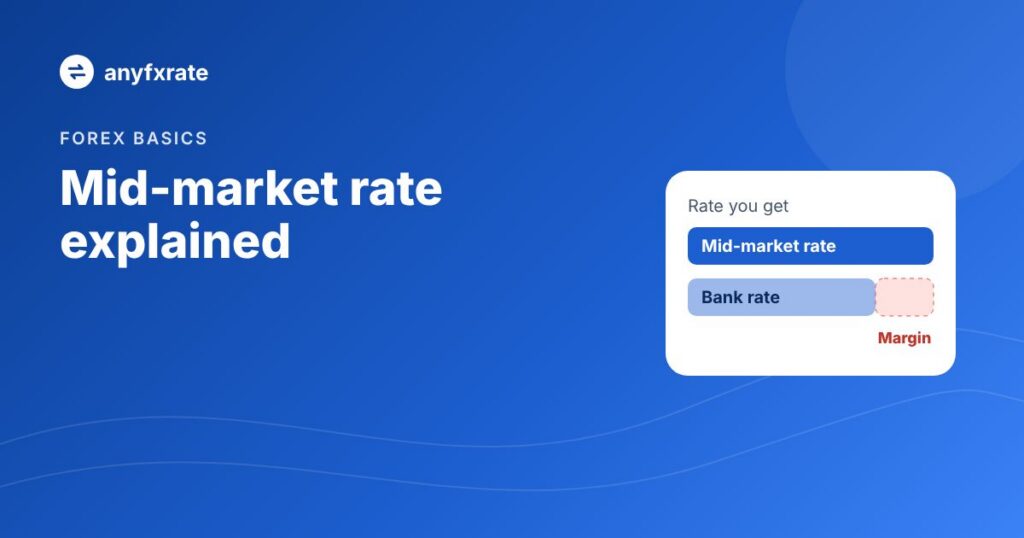
- Banks, exchange houses, card networks and apps add a margin to it. That margin is a cost, even when there is “no fee”.
- Margin (%) = (mid-market rate − your rate) ÷ mid-market rate × 100.
- When paying abroad by card, choose to pay in the local currency to avoid an extra conversion markup.
You check a currency rate online, then your bank or exchange counter offers something noticeably lower. Nothing is wrong with your search: you are looking at two different rates. Understanding the difference helps you spot expensive deals and save money every time you exchange or send money.
What is the mid-market rate?
On global currency markets, banks and large institutions constantly quote two prices for every currency pair: a bid (the price they will buy at) and an ask (the price they will sell at). The mid-market rate is exactly halfway between the two.
It is also called the interbank rate or the spot mid rate. It is the fairest single reference for what a currency is worth at that moment, and it is the rate shown in our currency converter.
Why you rarely get the mid-market rate
Businesses that exchange money for you need to cover their costs and make a profit. Most do it in two ways:
- A visible fee, such as a fixed transfer charge or a commission.
- A margin in the rate: they give you a rate below the mid-market rate and keep the difference.
The margin is easy to miss because it is built into the number. A provider that advertises “zero fees” may still charge you through a wider margin.
How to calculate the hidden margin
You need two numbers: the mid-market rate and the rate you are offered. Then:
Margin (%) = (mid-market rate − offered rate) ÷ mid-market rate × 100
Example: the mid-market rate for USD to INR is 84.00 and your bank offers 82.32. The margin is (84.00 − 82.32) ÷ 84.00 × 100 = 2%. On USD 1,000, that is ₹1,680 less than the mid-market value.
Our converter’s Send cost tab does this for you: enter an amount to see what different margins cost in the receiving currency.
Typical margins by provider type
| Where you exchange | Typical approach | Tip |
|---|---|---|
| Airport exchange counters | Often the widest margins | Exchange only what you need on arrival |
| High-street banks | Moderate to wide margins, sometimes plus fees | Compare with a specialist provider for large amounts |
| Exchange houses | Competitive on popular routes; varies by brand | Check rates across two or three brands |
| Money transfer apps | Often low margins with a clear fee | Look at the total amount received |
| Cards abroad | Card network rate plus a foreign transaction fee | Pay in local currency, not your home currency |
The “pay in your own currency?” trap
When paying by card abroad, a card machine or ATM may offer to charge you in your home currency. This is called dynamic currency conversion. It feels convenient, but the rate used usually includes a large markup. Choose to pay in the local currency and let your card provider convert it.
Why rates change and when margins widen
Currency prices move with interest rates, inflation, trade flows and news. Pegged currencies such as the UAE dirham barely move against the US dollar, while others move every second.
When markets are closed at weekends, some providers widen their margins to protect themselves from Monday price moves. For large amounts, compare quotes on a weekday.
Using the mid-market rate to compare deals
- Check the mid-market rate for your pair, for example USD to INR or GBP to INR.
- Ask each provider for the final amount the receiver gets, after all fees.
- Divide that amount by what you pay to get your effective rate.
- Calculate the margin with the formula above and pick the smallest total cost.
Sending money home from the Gulf? Read our step-by-step guide on how to send money from the UAE to India, or ask our team to compare options for you.
Frequently asked questions
Is the mid-market rate the same as the Google rate?
Google and most converters show a mid-market rate from a data provider. Small differences between sites come from different data sources and update times.
Can I get the mid-market rate?
Some money transfer services convert at or very close to the mid-market rate and charge a separate, visible fee instead.
What is a good exchange-rate margin?
Under 1% is generally competitive for popular currencies; 2–3% or more is common at banks and much higher at airports.
Why does the rate change during the day?
Currency markets trade around the clock on weekdays, so supply and demand move prices continuously.
Example figures are for illustration only. This article is general information, not financial advice.